My family flew overnight - Karachi to Bangkok to Singapore - and I tracked the journey two ways at the same time. One path used a polished native AI travel scheduler. The other used my own agent over Telegram, wired into the same flight numbers and times.
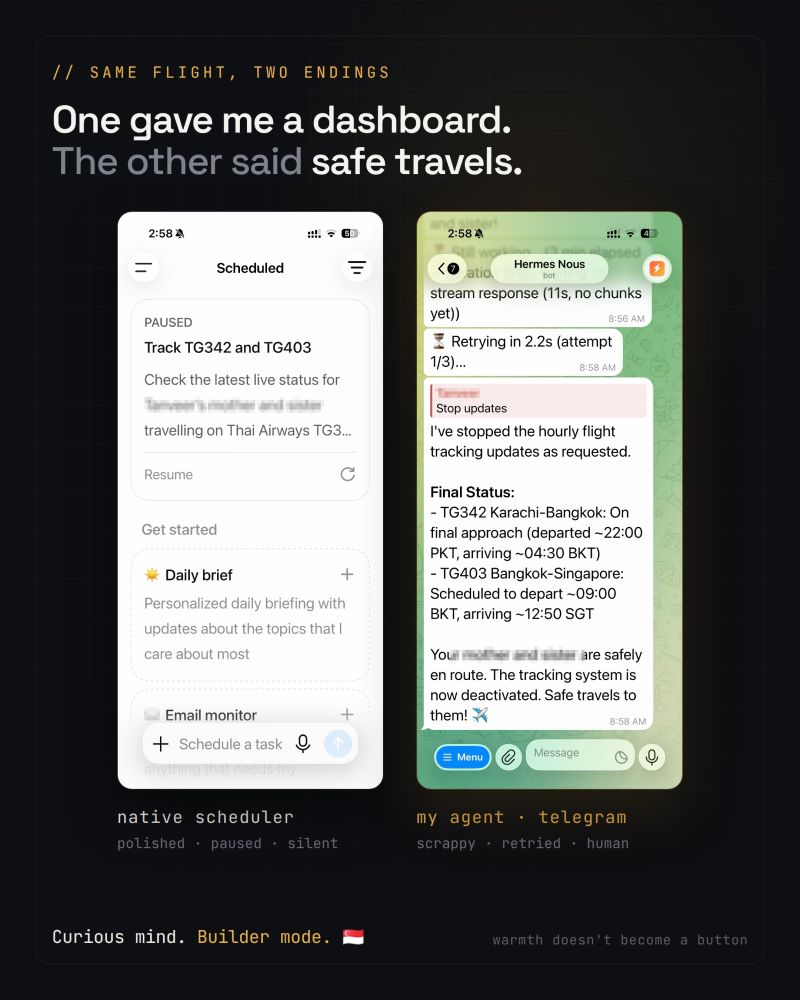
Ending one: the dashboard
The native AI app gave me a beautiful dashboard. Gates, delays, connection times, weather layers - everything a product manager would put in a launch screenshot. It was impressive. It was also generic - built for any traveler, optimized for visual completeness.
Ending two: "safe travels"
My Telegram agent knew who was flying, which leg mattered to me, and what "done" looked like: tell me when they're through immigration, when they're landside, when I should leave for the airport to pick them up. No dashboard. Just messages at the moments that mattered. The last one said "safe travels" when they cleared arrival. That was the whole UI.
The point isn't "build your own agent." It's that agents win when the job is narrow, personal, and event-driven - not when you need a general-purpose surface.
What I'd take into a product decision
Consumer AI apps compete on polish and breadth. Personal agents compete on context and timing. Both are valid. The mistake is using a dashboard product for a ping-me-when-it-matters job - or building a bespoke agent when users need exploratory browsing.
Same flight. Same data. Different harness, different ending. Match the shape of the product to the shape of the task.
I'm still building Hermes - local multi-agent assistant on a Mac Mini - around this idea: your hardware, your context, your triggers.
Also on LinkedIn →